THE MITCHEMP TRUST THE MITCHEMP TRUST

 WHAT WE DO WHAT WE DO
 HOW TO GET INVOLVED HOW TO GET INVOLVED
 EVENTS EVENTS
 WHAT'S NEXT WHAT'S NEXT
 GALLERY GALLERY
 PUBLICATIONS PUBLICATIONS
 DONATE NOW DONATE NOW
 JOBS JOBS
 CONTACT US CONTACT US
|
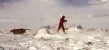
We shared our last flight (and our 5th from the UK) with a traditionally dressed Inuit Grandmother visiting her family for Easter, and one other local. You know you are in a different environment when the pilot also unloads the baggage - in our case two 100lb sledges or 'pulks' that held everything we were going to need for our 10 day trek through the Auyuittup Park, north of the Arctic circle.
There are two seasons this far North in the Canadian territory of Nunavut: Light and Dark. These are also known as the Seasons of the Bear and the Caribou and of the Igloo and the Skin tent. We were arriving in Bear time.
The Season of the Bear is also cold. We had an average temperature of between -15 and -25 degrees with temperatures in the tent often breaking the -30 mark. Wind chill, at times, took temperatures to immeasurably low levels and, as our route took us across 'Windy Lake' and through 'Windy Gap', we had our fair share of that. We walked in winds so strong that we were being pushed backwards on the ice: Winds that blow spindrift towards you at the speed and sound of a train, forcing you to involuntarily duck. Interesting things happen at these low temperatures: Plastic becomes brittle and snaps, steam from boiling water sinks like stage dry ice and exposed skin will sting like needles within 10 seconds or so. In the mornings the inside walls and roof of the tent were covered in a blanket of fine icicles as the moisture in our breath froze on contact.
We had been briefed by the Park Ranger of recent sightings of Polar Bears in the area and of the weather conditions we could expect. Polar Bears are very unlike the Grizzly and Brown Bears found in the Southern national parks. These are mainly vegetarian and will avoid contact with humans if possible. Polar Bears are predators, feeding mainly off Grey Seals, and are capable of travelling vast distances by land and sea in search of prey. It was pointed out to me on a number of occasions that ' Jason lying in sleeping bag' has an uncanny resemblance to 'Grey Seals lying on ice flow' so we carried Bear deterrents with us at all times. We slept better as we moved further in land away from the pack ice and by day 4 we were blasé about finding the large pads of fresh wolf prints across our path.
The route took us across Glacier Lake and Summit Lake - with vertigo inducing views down, past your feet, into the frozen waters beneath. Whilst walking across the middle of this huge lake I heard the loud crack of ice around me - like the twang of a high tension cable - and lake water start to well up around my cramponed boots. A primal fear runs through your mind as you realise that the 100lb sledge attached to you by a harness would also be a very good anchor. We made a careful, if not slightly urgent retreat and there followed a few minutes of loud swearing, in both Inuit and English&
Our journey took us 9 days and ended as we walked into the settlement of Pangnirtung. We were met by friendly, if not slightly bemused, locals. Why walk it when a Skidoo could do the trip in a day or so??! It is difficult to describe the sensations of reacclimatising into a world of buildings, heating, water on tap and eating food that hadn't been freeze dried and dehighdrated. I was tired but felt as alive as I can remember. Our journey had taken us through steep mountain valleys and over ultra-marine blue glaciers. We had crossed frozen seas in the shadow of pressure ice lifted as high as a house. As my words cannot do justice to this beautiful landscape, please take a look at the photos.
Jason Evans
Invesco Perpetual |
|
|
|